I was looking recently at an app in the accounting ecosystem that I thought could be a useful addition to our app stack at CASS, specifically to support some of our clients in a particular sector.
It’s currently a featured app on the Xero App Store, and from what I could see, it looked like it could solve a genuine problem for those clients. So I wanted to understand how it worked, how we could support clients using it and, importantly, what it would actually cost them.
Then I tried to work out the pricing.
I don't mean I looked at the price and thought it was expensive.
I mean I couldn't actually arrive at a price.
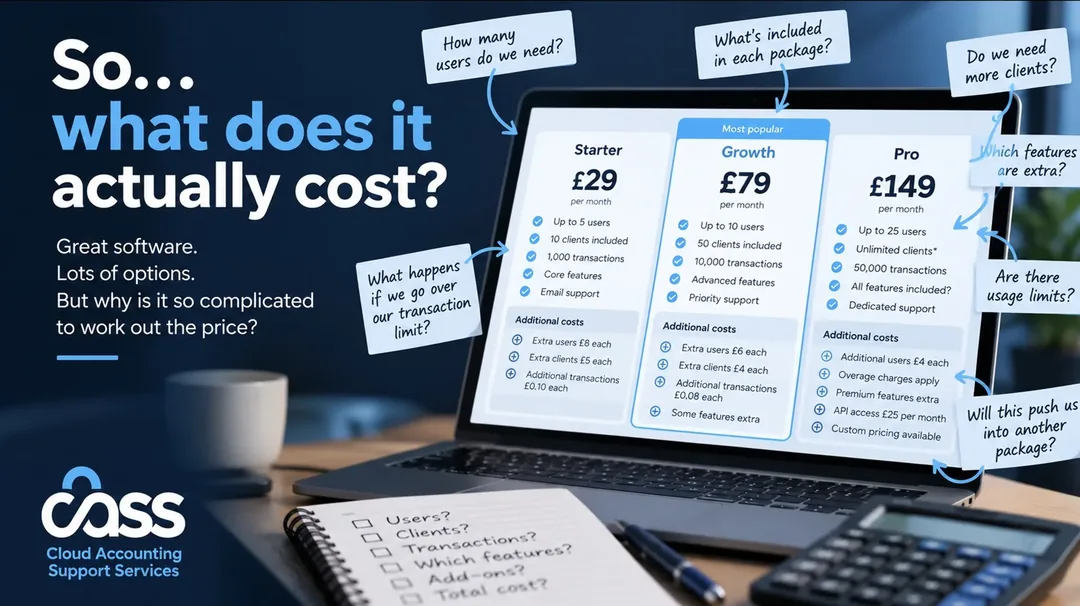
The answer depended on which package was needed, how many people would use it, transaction volumes and which features sat within which package.
After a while, I gave up.
And it got me thinking:
Why does buying accounting software need to be this complicated?
This isn't a complaint about one particular provider. I see it more and more across the accounting app ecosystem, and I suspect it's costing software companies more sales than they realise.
There are actually two different problems
When I first started thinking about this, I lumped everything together.
Users. Clients. Transactions. Tiers. Add-ons. Usage limits.
But I think there are actually two separate issues.
The first is feature tiers.
I'll admit, I find these frustrating. A software company develops something really useful, but we don't get to discover how useful it could be because it sits in the package above ours.
But I can also understand why tiers exist.
A two-person business shouldn't necessarily have to pay the same as a much larger organisation using far more advanced functionality. A few clearly defined packages can actually make pricing quite easy to understand.
It's the second issue that I think has become the bigger problem.
That's when pricing runs on several different measures at once.
There's a package price.
Then the number of users.
Then the number of clients or businesses.
Then transaction volumes.
Then perhaps an add-on or two.
Then a usage limit which moves you onto another package.
Individually, there may be perfectly good commercial reasons for every one of them.
Combined, I can't answer a very simple question: how much is this software actually going to cost?
I'm not looking for the cheapest option
That's an important distinction.
I'm perfectly comfortable recommending software that costs money if it saves time, improves processes or solves a genuine problem for a client.
Software companies need to make money too, and good software is worth paying for.
My objection isn't necessarily to the amount.
It's that I shouldn't need a spreadsheet to find out what the amount is.
Is one measure the answer?
One of the pricing approaches I like is the model used by Xenon Connect.
The principle is straightforward. Practices get the functionality and the price scales according to the number of organisations they're using it with.
More clients, more cost.
Fair enough.
I don't have to keep wondering whether a particular feature is included in our package or whether using something useful suddenly moves us onto another subscription level.
My first reaction was that perhaps every accounting app should do something similar.
Pick one sensible measure.
Users.
Clients.
Transactions.
Whatever makes most sense for the product.
Give me the software, let me use it properly and then charge me according to how much of it I use.
But the more I thought about it, the more I realised that isn't perfect either.
If we're paying per client, for example, we inevitably start deciding which clients are "worth" putting onto the software.
A client who would benefit a little might get left off because each additional client adds to the bill.
That's actually the same adoption problem I have with feature tiers, just arriving by a different route.
Usage-based pricing can also make costs harder to budget because the price moves as usage grows.
So perhaps there isn't one perfect pricing model.
Why this matters particularly to accountants
Accountants sit in a slightly unusual position when it comes to software.
Sometimes we're choosing technology for our own practice. But increasingly, we're also helping clients choose technology that solves problems within their business.
That might be document capture to make record keeping easier, payment software to improve the way suppliers are paid, credit control software to help get invoices paid quicker, forecasting tools to understand what's coming, or reporting software to give the management team better information.
We're not necessarily the end user and it isn't always solving an accounting firm's problem.
But we're often the person recommending it, supporting it or helping integrate it into the wider finance function.
And that means we need to understand what it's going to cost.
If I recommend an app to a client, one of the perfectly reasonable questions they're going to ask is:
"How much is this actually going to cost us?"
That's where complicated pricing becomes a problem.
The answer shouldn't require me to work through which package they need, how many people will use it, how many transactions they'll process, which features they need and whether one of those features pushes them into another tier.
Because ultimately, we're trying to solve a business problem.
Does this software do what the business needs it to do, and does the benefit justify what it's going to cost?
The harder it is to establish the second part, the harder it becomes to recommend the software with confidence.
And I suspect this has a commercial consequence that software providers don't always see.
If two apps can broadly solve the same problem, but I can clearly explain the cost of one to my client and can't confidently explain the cost of the other, that simplicity becomes part of the buying decision.
The provider with the more complicated pricing may never even know that's why they lost the recommendation.
We've had to look at this ourselves
I need to be careful criticising software pricing because accountancy pricing isn't exactly simple either.
What we charge at CASS depends on the services a business needs, transaction volumes, payroll numbers and several other factors.
So if I tell a software company they should only price using one metric, they could quite reasonably ask:
Why don't you?
And they'd have a point.
What we've done instead is try to remove that complexity from the person buying from us.
Someone visiting the CASS website can now answer a handful of questions and build an indicative price for the services they need before they ever speak to us.
It isn't a final quote. Some businesses don't fit neatly into the model and we'll always verify the information before confirming a fee.
But here's the important bit:
Our pricing underneath didn't suddenly become simple. We just stopped asking the customer to do the working out.
And I think that's probably the more realistic ask of software providers too.
Make the buying bit simple
Price your software using whatever measures genuinely make commercial sense.
Users, clients, transactions, features, volumes — perhaps you genuinely need a combination of them.
But if you do, give me a simple calculator.
Let me enter the number of users, clients and expected volumes and show me what I'm likely to pay each month.
Don't make me move between pricing tables, feature comparisons and FAQs trying to calculate it myself.
And please don't make me book a demo just to find out the price.
Because perhaps the answer isn't that software pricing itself has to be simple.
The buying experience does.
If there's complexity underneath, that's fine.
Just don't make your customer unravel it.
Because if I need to build a spreadsheet just to work out what your software subscription is going to cost me, something has gone wrong.
I'd genuinely be interested to hear what others think.
Has complicated pricing ever stopped you adopting or recommending an app you otherwise liked? And which accounting software providers do you think make it really easy to understand what you'll actually pay?
Need help with this?
Every business is different — tell us about yours and we'll recommend the support that's right for you.
Let's Talk