Like a lot of people, I was watching England's opening World Cup game against Croatia the other night.
A great result. Four goals, plenty of attacking football and, judging by Thomas Tuchel's reaction afterwards, exactly the sort of second-half performance he'd been looking for.
As I was watching, it got me thinking.
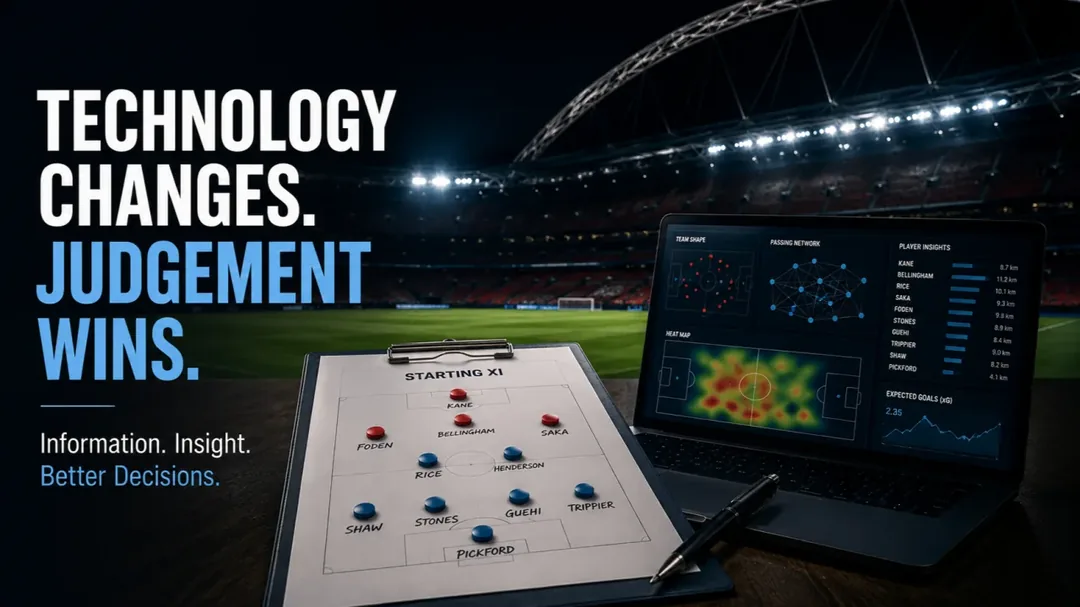
Thomas Tuchel probably has more information available to him than any England manager in history. Player fitness, opposition analysis, training data, performance statistics... the list goes on. Add AI into the mix, and he'll have more data than managers could ever have imagined even ten years ago.
But can you imagine him walking into the dressing room before kick-off and saying,
"Morning lads... AI's picked the team today."
Of course not. He'll use every bit of information available to him.
Then he'll use his experience, judgement and understanding of the game to make the final decision.
To me, AI in business is exactly the same.
There's been a lot of talk recently about AI replacing accountants. Personally, I don't see it that way. In fact, I think AI is one of the biggest opportunities our profession has seen.
Used properly, it can analyse information in seconds that would previously have taken someone hours. It can identify trends, highlight anomalies and challenge our thinking in ways we've never had before.
That's exciting.
But better information doesn't automatically lead to better decisions.
Over the last few months I've been experimenting with AI quite a bit, and one thing has become really clear to me.
The quality of the answer almost always comes down to two things.
The quality of the information you give it.
And the quality of the question you ask.
Get either of those wrong, and the answer quickly loses its value.
I've met plenty of business owners who already have lots of information.
Bank balances, Sales reports, Year-end accounts, Dashboards.
What they're often missing isn't information.
It's understanding what that information is actually telling them.
It's no different in accounting.
If your bookkeeping isn't accurate, AI won't fix it, it'll simply give you the wrong answer much more quickly.
If your data is incomplete, your answers will be incomplete.
And if you're asking the wrong questions, even the smartest AI in the world won't give you the insight you're looking for.
That's why I actually think AI makes good bookkeeping even more important than it was before.
The businesses that will get the most from AI won't necessarily be the ones with the latest software.
They'll be the ones with accurate, up-to-date financial information that AI can actually analyse properly.
But there's something else technology can't replace. Experience.
I've worked with hundreds of business owners over the years, and very rarely has the biggest challenge been finding an answer.
More often, it's knowing which question needs asking in the first place.
Can your cash flow cope if sales grow by 20%?
Which customers are actually making you money?
Are you growing profitably, or are you simply getting busier?
Those questions don't come from software.
They come from experience.
They come from understanding businesses, recognising patterns and knowing where to look before a small issue becomes a big one.
The more I use AI, the more convinced I become that the future isn't accountants versus AI. It's accountants who know how to use AI well.
Just like Thomas Tuchel won't let AI pick his team, business owners shouldn't let AI make their decisions either. Use AI to gather information. Use it to challenge your thinking. Use it to explore possibilities. But don't stop asking questions, don't stop applying experience and don't stop using judgement. That's the part AI can't replace.
Technology will continue to evolve. It'll become quicker, smarter and more accessible. But I don't think the fundamentals of running a successful business will ever really change.
Because the future isn't about having more information.
It's about turning information into insight... and using that insight to make better decisions.
Need help with this?
Every business is different — tell us about yours and we'll recommend the support that's right for you.
Let's Talk