AI Bookkeeping: Are You Saving Money or Creating Problems You Can't See?
There is a lot of noise at the moment around AI agents and how they can replace some of the functions traditionally carried out by bookkeepers and accountants.
As a business owner, I completely understand the attraction. If an AI agent can process your invoices, reconcile your bank transactions, categorise your expenditure and produce financial reports, why wouldn't you look at it as an opportunity to reduce your accountancy fees?
I'm a big advocate of technology and, across #teamCASS, we actively embrace automation and AI where it adds value to what we do. But there is a difference between using technology to improve a process and relying on technology to take responsibility for it.
My concern isn't necessarily what AI agents can do. It's what business owners might not realise they haven't done, or haven't done correctly.
Can AI agents replace your bookkeeper?
AI agents can automate many of the repetitive tasks associated with bookkeeping. They can extract information from invoices, suggest transaction categories, match payments and identify patterns within your financial data.
All of this has the potential to save time and reduce the cost of processing financial transactions.
But bookkeeping isn't simply about getting transactions into accounting software. It's about understanding those transactions, why they have occurred, how they should be treated and what impact they have on the financial position of the business.
There is a significant difference between a transaction being processed and a transaction being processed correctly.
A bank account that is fully reconciled in Xero doesn't necessarily mean the underlying accounts are accurate.
The hidden risks of automated bookkeeping
One of the biggest challenges with AI-powered bookkeeping is that inaccuracies aren't always obvious.
An AI agent may recognise a supplier and consistently allocate its invoices to the same expense category. But what happens when that supplier provides something different? What happens when an item should be treated as a fixed asset rather than an expense, or when the VAT treatment changes?
Some of the less visible challenges include:
Incorrect allocation of income and expenditure.
Incorrect VAT treatment and potentially inaccurate VAT returns.
Duplicate invoices or transactions.
Capital expenditure being treated as an everyday business expense.
Missing accruals, prepayments and deferred income.
Incorrect treatment of directors' loan accounts.
Transactions being recorded in the wrong accounting period.
Unidentified or incorrectly allocated customer and supplier balances.
Individually, some of these may appear relatively insignificant. Over several months, however, they can build into a financial position that looks very different from the reality of the business.
And unless someone with the appropriate knowledge is reviewing the accounts, how would you know?
What happens when AI gets your financial reporting wrong?
This is where, for me, the conversation becomes far more important.
If you're using your financial reports simply to establish how much tax you might need to pay at the end of the year, you may not immediately appreciate the impact of inaccurate bookkeeping.
But if you're using your numbers to make decisions about your business, the implications are very different.
Imagine making a decision to recruit another employee because your profit and loss report suggests the business can afford it. What if that profit is overstated because some costs haven't been recognised in the correct period?
What if you're reviewing your pricing based on gross profit margins that are inaccurate because expenditure has been allocated incorrectly?
Or you're planning an investment based on a cash flow forecast that doesn't properly reflect your outstanding liabilities?
The reports themselves may look great. They may even come with an AI-generated commentary explaining how well your business is performing.
The problem is that the commentary is based on the information it has been given.
An AI-generated financial report can be convincing, professionally presented and completely misleading at the same time.
Will AI bookkeeping really reduce your accountancy fees?
Potentially, yes.
If you're paying someone purely to process transactions, AI and automation may reduce the amount of time required to undertake that work.
But there is another cost that needs to be considered.
If your accountant receives twelve months of AI-processed bookkeeping at the end of your financial year and has to spend time reviewing, correcting and unpicking transactions, how much of that initial saving will you actually have made?
We've seen businesses over the years where the cost of putting their accounts right has been considerably more than it would have cost to maintain them correctly in the first place.
That's not a problem created by AI. It's a problem that has existed for years with poorly maintained bookkeeping. AI simply has the potential to make those inaccuracies happen more quickly, at greater scale and with less visibility.
There is also the cost of the decisions you may have made throughout the year based on inaccurate financial information. That's a cost that is much harder to quantify.
AI doesn't necessarily understand your business
Two businesses operating in the same sector can have very different business models, different revenue streams and different ways of managing their finances.
Even within the same business, the treatment of a transaction may depend on circumstances that aren't apparent from an invoice or a bank transaction.
Understanding the business, having regular conversations with the business owner and knowing what's happening beyond the numbers are all important parts of maintaining accurate financial information.
An AI agent can be given context and rules, but someone still needs to establish those rules, recognise when circumstances change and take responsibility for the accuracy of the output.
That relationship between a business and its finance team is something I believe we need to place more value on, not less.
Who is responsible when AI bookkeeping goes wrong?
Using AI to maintain your bookkeeping doesn't remove your responsibilities as a business owner or company director.
You still need to ensure that appropriate accounting records are maintained and that the information used for your tax returns, VAT returns and statutory accounts is accurate.
It's also worth understanding where your financial information is being processed, how it's being stored and what access you're giving an AI agent to your accounting software and potentially sensitive business data.
Before introducing AI agents into your finance function, it's worth establishing who is responsible for reviewing their work, correcting inaccuracies and ensuring that appropriate financial controls remain in place.
How should businesses use AI in their finance function?
I don't believe the conversation should be about choosing between AI and an accountant.
It should be about how the two can work together to deliver better outcomes for the business owner.
At CASS, we see technology as an opportunity to spend less time processing financial information and more time helping our clients understand it.
If we can automate a process without compromising accuracy, that's a good thing. If we can use AI to identify trends, highlight unusual transactions or bring something to our attention that warrants further investigation, even better.
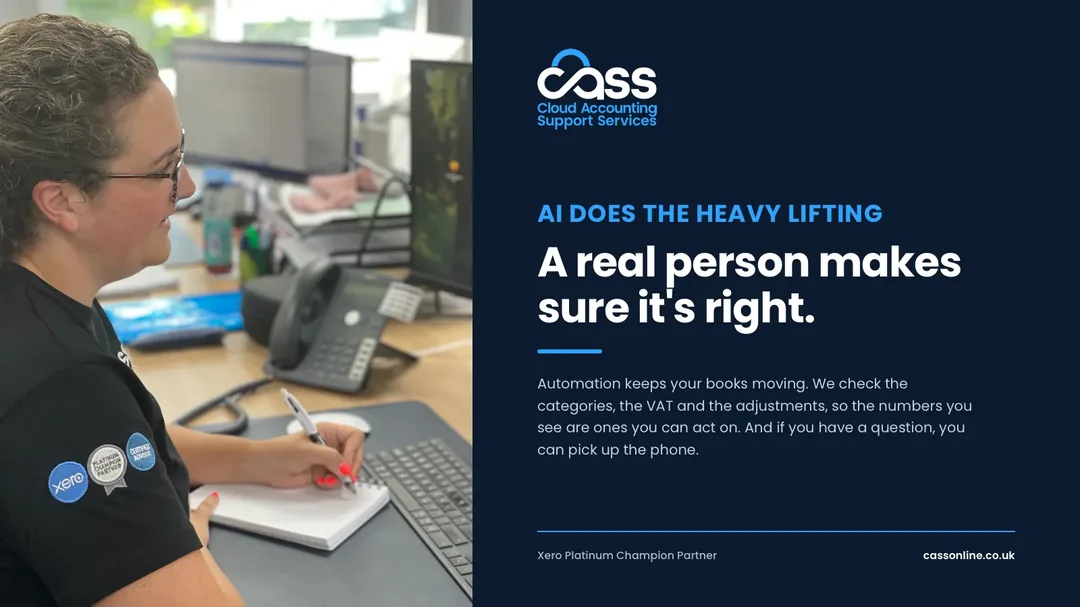
But the information still needs to be reviewed, challenged and understood.
For me, the opportunity AI presents isn't necessarily about removing the finance team. It's about allowing the finance team to spend more time providing the insights, advice and strategic support that business owners should be receiving.
Are you buying bookkeeping or financial clarity?
Perhaps this is where business owners need to reconsider what they're actually paying their accountant for.
If the relationship with your accountant is purely transactional, with little interaction beyond processing your bookkeeping, submitting your VAT returns and producing your year-end accounts, I can understand why replacing some of that work with AI might be attractive.
But your finance function should be delivering considerably more than that.
You should have confidence in your numbers. You should understand how your business is performing, where your challenges are and what opportunities exist. You should be able to use your financial information to make informed decisions about where your business is heading.
That's where I believe the real value of an accountant and an outsourced finance team sits.
I'm all for using AI to make accounting more efficient. What I wouldn't want to see is business owners saving a few hundred pounds in accountancy fees only to lose thousands through decisions made on the back of inaccurate financial information.
The value of your numbers isn't in how cheaply they can be produced. It's in what you can confidently do with them.
Frequently asked questions about AI bookkeeping
Is AI bookkeeping accurate?
AI bookkeeping can be accurate when properly configured, monitored and reviewed. However, automated systems can misinterpret transactions, apply incorrect accounting treatments and overlook adjustments that require professional judgement.
Can AI replace a bookkeeper or accountant?
AI can automate many routine bookkeeping tasks, but it cannot reliably replace all the professional judgement, financial oversight, business understanding and strategic advice provided by an experienced finance team.
Can AI agents manage bookkeeping in Xero?
AI agents and automation tools can integrate with Xero to process invoices, categorise transactions and assist with reconciliations. Appropriate permissions, financial controls and regular reviews remain important to ensure the underlying financial information is accurate.
Is AI bookkeeping cheaper than using an accountant?
AI bookkeeping can reduce transaction processing costs. However, businesses should also consider software costs, ongoing monitoring, correcting inaccuracies and the potential financial impact of decisions based on unreliable information.
Can I use AI to prepare my VAT returns?
AI can assist with preparing the financial information used in VAT returns. However, correct VAT treatment, completeness of records and compliance with HMRC requirements still need to be considered. The business remains responsible for its VAT submissions.
What is the best way to use AI in accounting?
Combining AI and accounting automation with experienced human oversight allows businesses to benefit from greater efficiency while maintaining financial accuracy, appropriate controls and access to meaningful financial insights.
At CASS, we combine cloud accounting technology, automation and an experienced outsourced finance team to help business owners understand their numbers and make better-informed decisions.
Let's talk about your business.
Giving You More Than Numbers.
Need help with this?
Every business is different — tell us about yours and we'll recommend the support that's right for you.
Let's Talk